Tech Job Market in July 2026: The AI Divide Accelerates
AI engineer demand surges 59% while general software roles collapse. Layoffs continue, but hiring budgets rise—it's not one market, it's two. What this means for your job search.
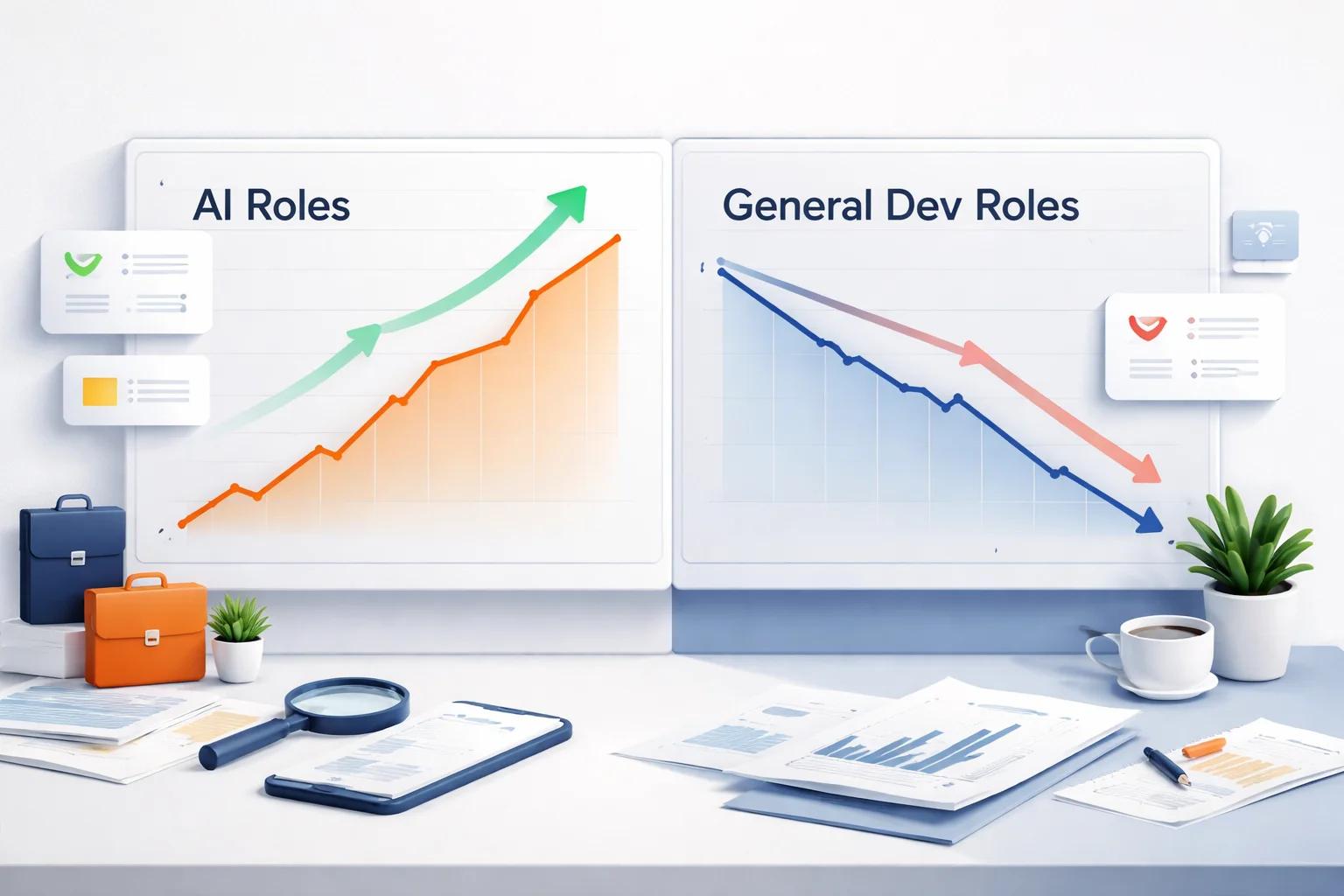
Two Markets, One Industry
The tech job market in mid-2026 is not recovering or collapsing—it's splitting. Overall US tech job listings sit roughly 36% below their February 2020 baseline, while machine learning engineer openings are up 59% over the same period, according to data through July 2025. General software engineering positions are down 49%.
This bifurcation explains why "tech is hiring" and "tech is laying off" are both true. The same recruiter is now sourcing two very different talent pools at once: a contracting market for general developers and a hot, scarce, expensive market for AI and machine learning specialists.
Layoffs Accelerate on AI Justification—But the Reality Is Nuanced
As of July 20, 2026, there have been 302 layoff events in 2026, impacting 201,754 workers. But not all layoffs are AI-driven. 54% of layoff events (164 out of 302) explicitly cite AI, automation, or machine learning as a contributing factor, impacting approximately 168,770 workers.
There's a pattern worth understanding: Companies are cutting roles where AI tools handle the output: basic CRUD development, manual testing, template-based design, and data entry. They are hiring for roles where AI tools need human guidance: AI engineering, prompt engineering, system architecture, and AI governance. Entry-level developer roles have declined 20% to 35% globally in the past year. CIO magazine reported that demand for junior developers is softening as AI takes over their typical tasks.
The Salary Story: AI Specialists Command a Growing Premium
Robert Half's 2026 Salary Guide pegs the national software engineer range at $109,250 to $175,500, vs. $134,000 to $193,250 for AI/ML engineering. That's roughly a $25,000 floor premium. The premium widens at senior levels: AI staff engineers earn 18.7% more than non-AI peers.
For non-AI roles, salary momentum has stalled. The average U.S. tech salary in 2025 was $112,521, a modest 1.2% increase year-over-year.
Hiring Budgets Rise Even as Layoffs Continue
The paradox that defines mid-2026: 41% of employers plan to reduce their workforce as AI automates certain tasks. But 92% of companies say they plan to hire new people this year. Tech job postings increased 3% month-over-month in June, consistent with the sustained expansion that has held for most of 2026. Year-over-year, postings are up 27% compared to June 2025.
The shift is happening fast. AI skill requirements reached 75% of U.S. tech job postings in June, up from 73% in May. AI fluency now sits at the center of most tech hiring rather than at its margins.
Remote Work: Mandates vs. Expectations
Demand for remote and hybrid roles has stayed consistently high since 2020. At the same time, companies are pulling back from remote-only structures. Recent surveys indicate that around 30% of organizations plan to reduce or eliminate remote work in 2026. Yet, 76% of workers said they'd quit if they're no longer allowed to work remotely, and 85% of job seekers cited remote work as a primary factor in their search.
Remote job postings increased 4% in Q4 2025, with the majority for experienced roles (67%), followed by manager (19%), senior manager (9%), and entry-level (6%). The divergence is clear: companies are opening remote roles for experienced talent while shutting the door on entry-level candidates, whether on-site or remote.
What This Means for You
If you're a general software engineer or entry-level developer, the market is tougher than 2020. Workers who develop AI literacy and learn to work alongside AI tools are better positioned to navigate this transition. If you're targeting AI, ML, or security roles, demand exceeds supply, and salary premiums are real.
For international job seekers and visa sponsors: The US Bureau of Labor Statistics projects 17% employment growth for software engineers through 2033. That is 327,900 new jobs. But those jobs will concentrate in AI-adjacent and specialized roles. Hiring managers are moving away from commodity developer profiles toward specialists who can architect or govern AI systems. Your job search strategy should reflect which market you're actually competing in.